Monday, October 13, 2014

LearnBoost Online Grade Book


I have sent our invitations to the 4th - 6th grade parents to join LearnBoost.  By joining LearnBoost and using the provided access code you will be able to access your student's grades on quizzes, tests and homework.  I will send out 7th and 8th grade invitations soon.

Please do not worry if your student has a poor grade on a quiz or test.  I have an unlimited retake policy and encourage students to keep coming back to a topic until they master it.

New videos uploaded to the 7th grade videos page

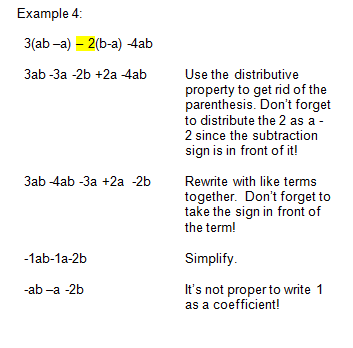
Combining like terms


Sunday, October 12, 2014

This week - 8th grade


Monday:  factoring trinomials with a leading coefficient of 1 lecture, notes, guided examples and practice


Wednesday: factoring trinomials review and activity

Thursday:
Practice and review of factoring
Quiz 3, Factoring GCF, Perfect Squares, Trinomials
Quiz Retakes during class when Quiz 3 is finished

Friday:

Return Quiz 3
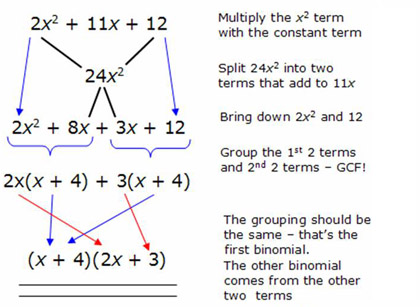
Lecture, notes and guided practice on factoring trinomials with a non-zero leading coefficient,


This week 7th Grade


Monday: Quiz 2 on Order of Operations and Expressions

Wednesday: Combining Like Terms Lecture, Notes and Guided Examples

Thursday: Combining Like Terms Whole Class Review and Activity

Friday: Simplifying Expressions


Quiz on Wednesday October 22, 2014

What we are doing this week - 6th grade Ratios and Proportions


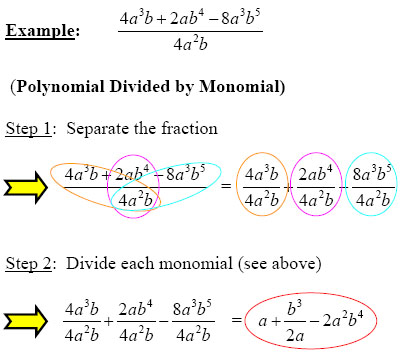
8th graders - dividing a polynomial by a monomial


All of you need to practice this skill.

Here is a Khan Academy video explaining the steps to simplifying this type of expression.

My advice is that when you see this type of problem written like (4x^2 - 5x + 10) ➗2x convert it into fractional form with a numerator and denominator:

4x^2 - 5x + 10
----------------
         2x


Saturday, October 11, 2014

What I am reading - Perceptual Learning


I am very interested in the psychology of learning. I was Googling around today to try to nail down the difference between associative learning and pattern recognition (there is a difference) and came upon this little gem (Kellman et al, 2010).

I have observed students learning through exposure to correct solutions without an explicit explanation but have not had a framework for understanding this process. From page 7:


Implicit pattern recognition versus explicit knowledge. Although PL may provide important scaffolding for explicit, verbalizable knowledge, PL itself need not involve explicit knowledge. PL changes the way a learner views a problem or representation; this idea of ‘‘mind as pattern recognizer’’ (Bereiter & Scardamalia, 1998) need not be accompanied by explicit facts, concepts, or procedures. In some domains, one might be able to demonstrate a ‘‘double dissociation’’ between PL effects and effects of con- ventional instruction. Whereas conventional instruction may lead to verbalizable knowledge but lagging pattern recognition and fluency, PL may produce the reverse. Such a clear division, although imaginable, may in practice be difficult to observe, because these forms of learning are normally synergistic, producing performance out- comes in which pattern recognition, facts, concepts, and procedures interact.  

There is much more to this. One very interesting insight is that students using PL methods will be able to "see" the solution prior to being able to verbalized the rationale for the solution method.

Learning is a very weird process and that makes teaching hard.


Kellman, Philip J., Christine M. Massey, and Ji Y. Son. "Perceptual learning modules in mathematics: Enhancing students’ pattern recognition, structure extraction, and fluency." Topics in Cognitive Science 2.2 (2010): 285-305.